From Chinese Suppliers to Container Loading: Your Cargo Journey in a Yiwu Consolidation Warehouse
- October 28, 2026
- 9 min read
- Dragon3PL Team
The Complete Journey of a Carton in a China Consolidation Warehouse
You are sourcing products from several Chinese suppliers.
A few days later, they gradually tell you:
“The goods have arrived at the Yiwu warehouse.”
And then?
From this moment, your cargo enters a journey that you cannot directly see.
Who received your goods? Were the quantities checked? Were the products inspected? Were any problems found? When can container loading be arranged? When will customs clearance be completed? When will your cargo actually be loaded into a container and leave China?
For many overseas buyers, the period between supplier shipment and receiving the bill of lading often feels like a black box.
You know your goods have arrived at the warehouse, but you do not know what happens every day.
In reality, from the moment a carton leaves a Chinese supplier until it is loaded into a container and shipped out of China, it goes through multiple steps:
| Warehouse & Inspection | Value-Added Services & Export Preparation |
|---|---|
| Receiving registration · Quantity verification · Product inspection · Warehouse storage | Multi-supplier consolidation · Relabeling · Kitting · Repacking · Container loading planning · Container loading · Customs declaration & export |
In this article, we will follow the real journey of a carton inside a Yiwu consolidation warehouse and explain each stage step by step.
This article shows a typical consolidation process. The actual timeline may vary depending on:
Supplier delivery schedule;
Product type;
Whether value-added services are required;
Container availability and shipping schedule.
Some orders may be completed faster. Others may take longer because they are waiting for supplier deliveries or require additional processing.
However, regardless of the exact timeline, cargo usually goes through a similar process.
The cases and numbers mentioned in this article all come from real projects we have previously shared, including:
Moving-ear plush hat inspection case;
56,000-piece product relabeling project;
30,000-set kitting project;
20GP container loading case;
40HQ container loading case;
Customs inspection case.
All of these examples come from real warehouse operations.
Day 0: Your Cargo Usually Will Not Arrive at the Warehouse on the Same Day
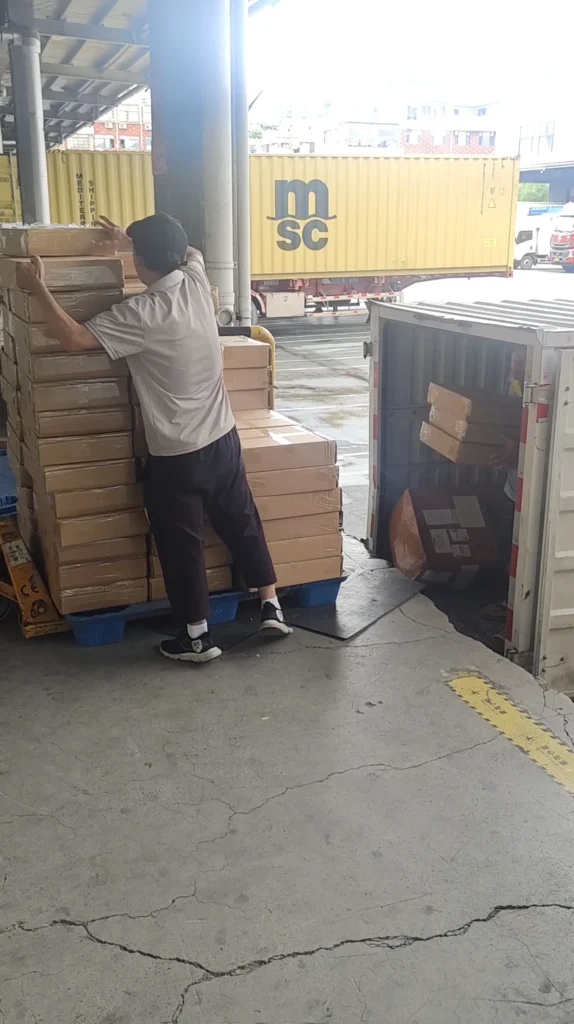
If you are purchasing products from several Chinese suppliers, the first thing that usually happens is:
Your cargo will not normally arrive at the warehouse on the same day.
Different suppliers have different production schedules and shipping arrangements.
Some suppliers ship immediately after production is completed. Others may need additional time for packaging, quality checks, or production adjustments.
Even if every supplier follows the original plan, their delivery times may still be different.
For example:
Supplier A delivers today;
Supplier B arrives two days later;
Supplier C may need several more days.
This is one of the reasons consolidation warehouses exist.
Your cargo does not need to wait until every supplier finishes production at the same time.
The warehouse can first receive completed shipments and continue tracking the remaining incoming cargo.
For you, this means you do not need to contact every supplier every day asking:
“When will my goods arrive?”
The warehouse needs to record the arrival status of each shipment and ensure different suppliers’ goods can eventually be consolidated according to your shipping plan.
(See the complete logic of multi-supplier consolidation: Multiple China Suppliers Consolidation)
However, one thing should be clear:
Goods arriving at the warehouse does not mean they are immediately ready for container loading.
The real warehouse process has only just started.
Day 1: What Happens During the First Hour After Your Cargo Arrives?
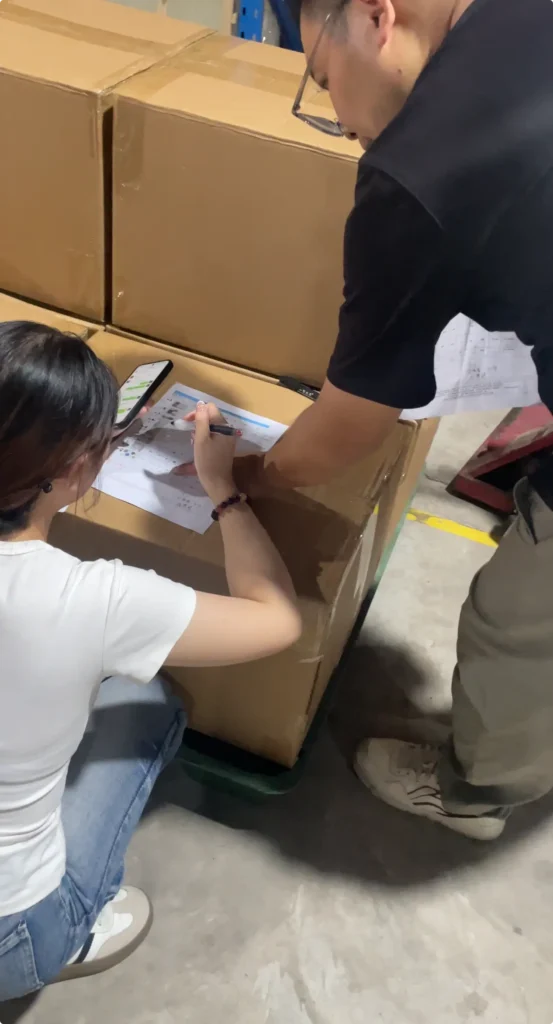
When a supplier’s truck reaches the warehouse, the first step is not simply moving the goods inside.
Before entering storage, your cargo needs to complete an identity confirmation process.
The warehouse needs to confirm:
Which supplier delivered the goods;
Which order they belong to;
How many cartons actually arrived;
Whether the outer packaging is intact;
Whether the shipment matches the information provided by the supplier.
For a consolidation warehouse, the most basic question is not:
“Do we have space to store the goods?”
The real questions are:
“Whose goods are these?” “Which project do they belong to?” “What should happen with them next?”
If receiving information is inaccurate, later steps such as inspection, storage, consolidation, and container loading may also be affected.
Many warehouse problems do not happen during container loading. They are already created during the receiving stage.
Therefore, receiving is not simply unloading cargo — it is the first step in creating a complete cargo record.
(See the complete receiving process: China Warehouse Receiving Process)
Day 1–2: How Will Your Cargo Be Inspected?

A common misunderstanding is:
Goods arrive at the warehouse, and the next step is waiting for container loading.
In reality, before loading, there is another important step:
Product inspection.
Products from Chinese suppliers are not all alike — different product types need completely different inspection focuses.
A warehouse does not use one fixed inspection method for every product.
Instead, inspection focuses on the risks and characteristics of each product.
Moving-Ear Plush Hats
We once handled a batch of moving-ear plush hats:
Quantity: 1,100 pieces
This product could not be checked only by appearance because it contained additional functional components.
The inspection focused on:
Whether the appearance was acceptable;
Whether the quantity was correct;
Whether the ear-moving function worked properly;
Whether the packaging met requirements.
During quantity verification, it was not always necessary to count every single piece.
Because the weight of each hat was relatively stable, sample weighing could be used as an additional method.
In the actual inspection:
10 hats weighed approximately 1.5 kg;
The average weight was around 150 g per hat;
One carton weighed 33.26 kg.
Weight comparison could help identify whether there was any obvious quantity shortage inside the carton.
Multi-Color and Multi-Style Products
The biggest risk with these products is finding the problem too late.
When problems are found in a China warehouse, there is usually still time to communicate and solve them.
However, if similar issues are only discovered after the goods arrive at the destination country, the cost of handling them can increase significantly.
Therefore, the key point of inspection for these products is not only counting quantities, but preventing mixing problems.
For example:
Incorrect colors mixed in the same carton;
Different styles packed together.
These issues can often be more troublesome than a small quantity difference.
For example, we handled a batch of multi-color hats:
Quantity: 1,550 pieces
The inspection focused on:
Style;
Color;
Quantity;
Packaging.
Multi-Specification Products
For example, a spray bottle project:
Quantity: 6,400 pieces 7 colors 3 capacities
For this type of product, the inspection focus changes to:
Color;
Capacity;
Quantity;
Appearance;
Packaging.
Different products have different risks.
Therefore, the purpose of inspection is not simply to decide whether a product is “good” or “bad”.
The real purpose is to identify problems in advance:
Which issues could affect your sales, transportation, or future use?
What Happens After Problems Are Found?
During inspection, if an abnormality is discovered, the warehouse does not directly decide the solution on your behalf.
The warehouse is responsible for:
Recording the facts;
Taking photos;
Providing inspection results;
Assisting communication with the supplier.
The final decision is made by you.
For example:
Requesting supplier rework;
Replacing products;
Negotiating a partial deduction;
Accepting a small issue and continuing shipment.
For example, during one inspection, a suspected scratch of less than 2 mm was found on one cow hat.
The handling process was:
Record the issue;
Save photos;
Notify the supplier and you;
You confirm the handling method;
Continue processing according to your decision.
Finally, the supplier agreed to deduct the cost of one product, and the cargo continued shipment.
The key point of this process is not the small defect itself.
The important thing is:
Before your cargo leaves China, you have the opportunity to see the problem and participate in deciding how it should be handled.
(See the complete inspection process of this shipment — three product types and three inspection methods: China Warehouse Product Inspection Case)
At this point, you should understand:
✓ Your cargo does not go directly into container loading after arriving at the warehouse ✓ The receiving stage first confirms cargo identity and quantity ✓ Different products require different inspection focuses ✓ After problems are found, you decide the final handling method
Day 2–3: Where Will Your Cargo Be Stored?
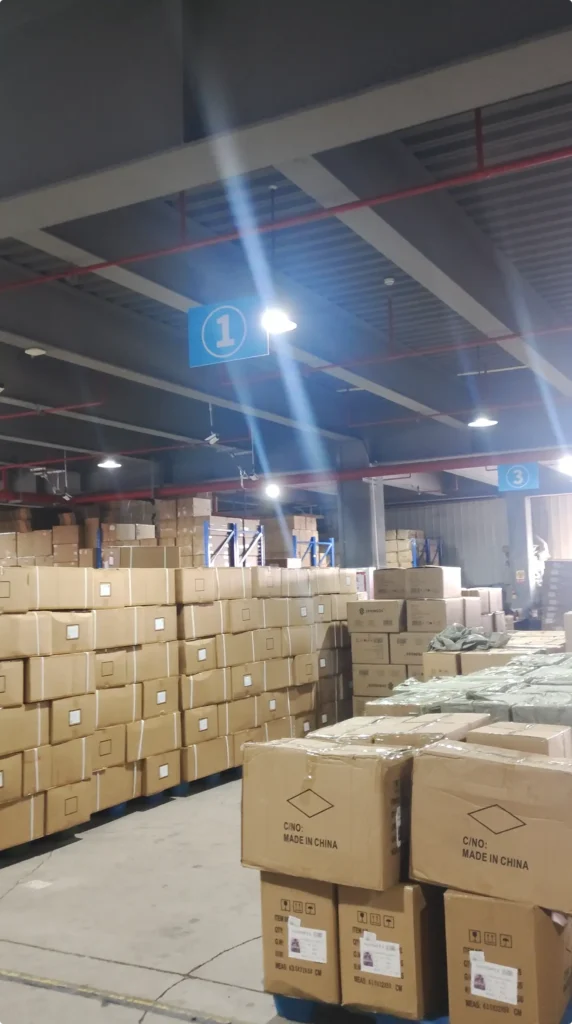
After inspection is completed, your cargo officially enters the warehouse storage stage.
A common misunderstanding is:
If a warehouse has empty space, goods can simply be placed there.
In reality, a consolidation warehouse needs to consider more than just:
“Is there available space?”
It also needs to consider:
Whether the goods can be found easily later;
Whether they can be clearly separated from other cargo;
Whether they can be inspected again if needed;
Whether they are convenient for future consolidation and container loading.
Because inside the same warehouse, there may be:
Multiple customers;
Multiple suppliers;
Multiple projects.
If cargo management is not clear, problems can occur in every later stage.
Cargo Management Inside a 900㎡ Warehouse
Our warehouse is currently approximately 900 square meters and is divided into 9 operation areas according to different working requirements.
This shows our current actual operation environment. Warehouse size and layout may be adjusted according to business needs, and different projects are managed based on actual requirements.
After goods enter the warehouse, they are managed according to:
Customer;
Project;
Future operation requirements.
For example, goods from different suppliers belonging to the same customer are kept under organized management whenever possible.
This makes future operations easier:
Quantity confirmation;
Cargo consolidation preparation;
Container loading planning;
Shipment handling.
At the same time, cargo from different customers and brands must remain clearly separated.
Your goods belong to your order. Other brands’ goods belong to other projects.
Physical separation is the most basic step in preventing cargo mixing.
(See how this warehouse area was built — including rack dimensions, materials, and cost calculations: Building Shelving in a Yiwu Consolidation Warehouse)
Why Does the Warehouse Consider Container Loading in Advance?
After goods enter storage, the process does not simply stop and wait.
In reality, some container loading preparation has already started.
For example:
Cartons from different suppliers may have different:
Sizes;
Weights;
Packaging methods.
If the warehouse waits until the loading day to decide:
Which cargo should go at the bottom;
Which cargo should go on top;
Which cartons should be loaded last;
it is usually already too late.
Therefore, during the storage stage, the warehouse needs to understand:
Cargo quantity;
Carton conditions;
Whether pallets are used;
Whether special handling is required.
For some export shipments, pallets may already be marked in advance with notes such as:
“Bottom layer” “Higher stacking”
This helps determine the loading order more efficiently during container loading.
At this point, you should understand:
✓ Storage is not simply finding an empty space and placing goods there ✓ The warehouse needs to consider future consolidation and container loading in advance ✓ Different customers and brands require clear separation ✓ Warehouse management and container loading methods are connected but not identical
Day 3–N: While Waiting for Consolidation, Is Your Cargo Just Sitting There?
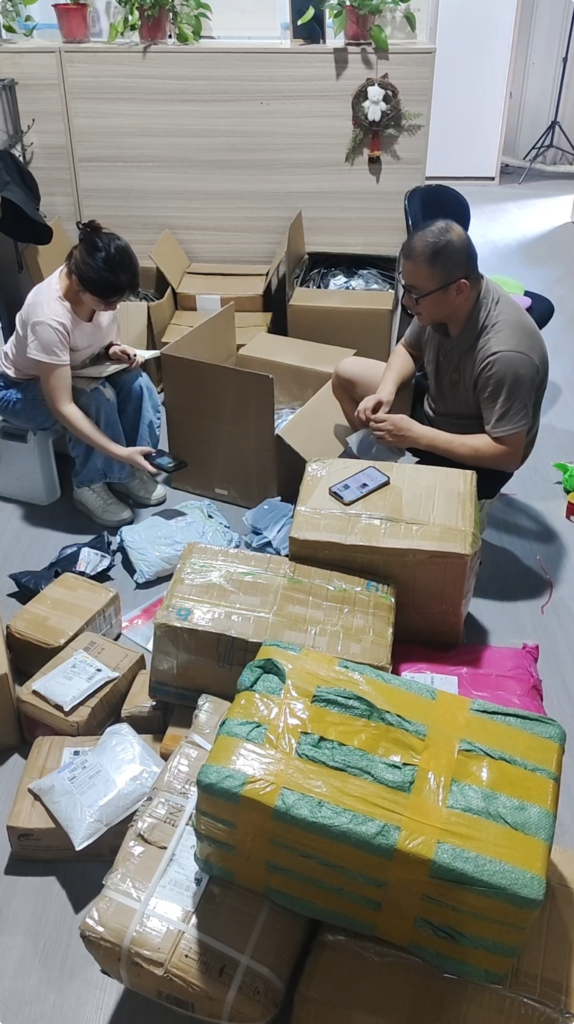
This is a stage that many overseas buyers may overlook.
When the first supplier’s goods have already arrived at the warehouse, but other suppliers have not completed delivery yet, your cargo usually needs to wait.
However, waiting does not mean nothing is happening.
In reality, many important value-added operations often take place during this period.
Relabeling: Preparing Products for Your Sales Requirements
If your products require new labels, barcodes, or packaging information, these tasks can usually be arranged during the waiting period before consolidation is completed.
We once handled a real relabeling project:
56,000 products 44 SKUs
The products were relabeled according to customer requirements.
Every unit needed to be processed according to the instructions, while keeping corresponding records.
For you, relabeling is not simply:
“Putting a new label on a product.”
The important parts are:
Whether the processed quantity is accurate;
Whether different SKUs match correctly;
Whether processed goods can still be tracked afterward.
Without proper records during these steps, it can become difficult to identify the cause if quantity or product model issues appear later.
(See the complete project process: Product Relabeling Case Study)
Kitting: Combining Multiple Components into One Sales Unit
Besides relabeling, Kitting is another common value-added service in consolidation warehouses.
A sales package may include:
Main product;
Accessories;
Instruction manuals;
Other components.
These items need to be combined into one complete sales unit before shipment.
We completed a real kitting project:
30,000 sets 6 accessories included Checked by set and shipped by carton
If this work is completed after arrival in the destination country, it usually increases additional labor requirements and processing time.
Therefore, many customers choose to complete this work in China before shipment.
What Else Can Happen During the Waiting Period?
Depending on your product type and order requirements, the waiting period may also include:
Repacking;
Packaging reinforcement;
Carton consolidation;
Quantity verification;
Final shipment preparation.
All of these operations have one common purpose:
They are not designed to add unnecessary steps.
They are designed to make your cargo better prepared for transportation and sales before leaving China.
This is also something we always believe:
Every charge should correspond to a real operation.
At this point, you should understand:
✓ While waiting for other suppliers, your cargo is not simply sitting in storage ✓ Relabeling, Kitting, repacking, and similar services are usually completed during this period ✓ Every value-added service should have corresponding records ✓ Pre-shipment processing can reduce additional costs after arrival in the destination country
Day N-3: Container Loading Is Not Decided on the Loading Day — It Is Planned in Advance
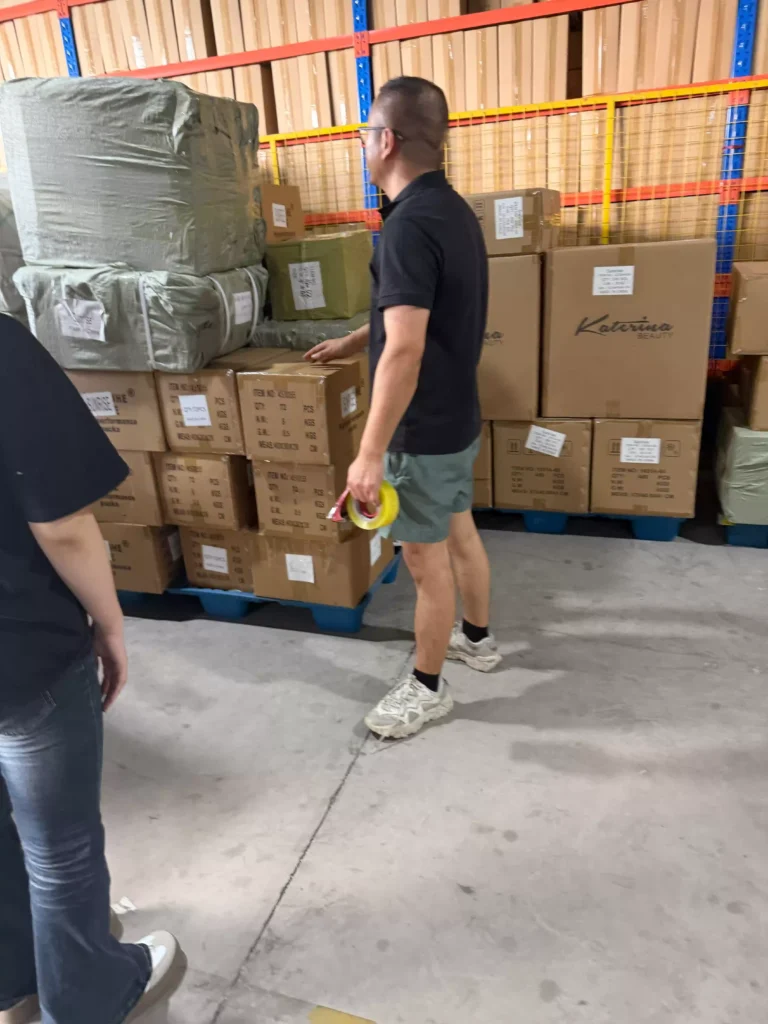
Many people arranging their first export shipment from China may think:
The container arrives at the warehouse, and then loading begins.
In reality, container loading is usually not something decided on the same day.
A proper loading plan is gradually developed after cargo enters the warehouse.
Because container space is limited.
Cargo from different suppliers may have different:
Carton sizes;
Weights;
Packaging strength;
Unloading requirements.
Without advance planning, problems may occur:
Low space utilization;
Difficulty unloading at destination;
Heavy cargo damaging lighter cargo;
Difficulty sorting goods after arrival.
Therefore:
Container loading is not simply putting goods inside a container. It is a process that requires advance planning.
This is also why your cargo cannot wait until the loading day to be organized.
If all cargo is only sorted on that day, the warehouse may not have enough time to confirm:
Which goods have already arrived;
Which products require special handling;
Which cartons are suitable for specific positions inside the container.
Advance loading planning reduces exactly these last-minute adjustments.
1. Carton Dimensions and Space Planning
Different suppliers usually use different carton specifications.
Some cartons are suitable for stacking.
Others may not be stacked freely because of:
Size;
Packaging structure;
Product characteristics.
Before loading, the warehouse needs to understand:
Quantity of each product;
Carton dimensions;
Carton weight;
Which goods can be combined together.
Only then can the container space be planned properly.
2. Loading Sequence
Container loading follows a basic principle:
Cargo that needs to be unloaded first is usually loaded later.
Cargo that will be unloaded later needs to be planned and positioned in advance.
Because after arriving at the destination port, cargo is not always unloaded all at once.
If the loading sequence is incorrect, it may cause a situation where:
Cargo inside the container must be removed before the required goods can be accessed.
This increases unloading time and operational costs.
3. Weight Distribution
Weight distribution is very important during container transportation.
Normally:
Heavy cargo is placed at the bottom;
Lighter cargo is placed on top;
Weight should be distributed as evenly as possible.
This helps reduce instability during transportation and lowers the risk of cargo damage.
4. Palletized Cargo and Loose Cargo Arrangement
Warehouses usually use pallet management internally.
However, during export loading, the actual method needs to be adjusted according to the shipment.
Some cargo is suitable to remain palletized.
Some cargo may need to be removed from pallets and manually stacked to improve space utilization.
The final method depends on:
Product characteristics;
Container type;
Destination requirements;
Shipping plan.
Real Container Loading Cases
We have shared several real container loading cases.
20GP Container Loading Case
In one 20GP container loading project:
327 cartons
Approximately 31 CBM
Export arranged together with cargo from another warehouse
From cargo preparation and space planning to final loading, every step required advance calculation.
(See the complete process: 20GP Container Loading China-Indonesia)
40HQ Container Loading Case
Compared with a 20GP container, a 40HQ provides more space.
However, more space does not necessarily mean easier loading.
A larger container often means:
More cartons;
More product types;
More complicated combinations of supplier cargo.
Therefore, planning becomes even more important:
Which cargo enters first;
Where each type of cargo should be placed;
Which cargo should be loaded last before sealing.
In our experience, even when only half of a container is loaded, cargo arrangement is still kept organized.
Because loading sequence is not decided on the loading day.
It is already considered during the storage stage.
(See the complete process: 40HQ Container Loading China)
At this point, you should understand:
✓ Container loading is not considered only after the container arrives ✓ Carton dimensions, weight, and unloading sequence all affect the loading plan ✓ Warehouse management and container loading planning need to connect in advance ✓ A full container is not necessarily a safe or efficient container
Day N-2: Customs Declaration and Customs Inspection
After container loading is completed, the shipment enters the export process.
This includes:
Document preparation;
Customs declaration;
Customs review;
Cargo release.
In most cases, the process follows the planned schedule.
However, sometimes cargo may be selected for customs inspection.
Customs Inspection Does Not Necessarily Mean There Is a Problem
For first-time exporters, hearing:
“Your cargo is selected for customs inspection”
may create concerns:
Is there something wrong with the goods?
Will the shipment be delayed?
Can the cargo still be exported?
In reality, random inspections are a normal part of international trade.
The most important things are:
Whether cargo information is accurate;
Whether documents are consistent;
Whether the products match the declared information.
With proper preparation, customs inspection can usually be completed according to normal procedures.
A Real Customs Inspection Case
We once recorded a real export customs inspection process.
During the entire process:
Cargo information matched the declaration documents;
Product conditions met the requirements;
After inspection, the shipment continued normally.
This case shows:
Customs inspection itself is not something to fear.
The key thing to avoid is inconsistency between:
Cargo;
Documents;
Declaration information.
(See the complete case: China Customs Inspection Case)
At this point, you should understand:
✓ After container loading, export procedures still need to be completed ✓ Customs inspection is a normal part of international trade ✓ Accurate documents and consistent cargo information are extremely important
Day N: Container Sealing, Loading on Vessel — What Happens Next?
After the container is fully loaded and export procedures are completed, your cargo enters the final shipping stage.
After the container is sealed, you will normally receive relevant shipment information, including:
Container information;
Vessel schedule;
Bill of lading information.
From this moment, your cargo officially leaves China and enters international transportation.
However, this does not mean the warehouse process becomes meaningless.
Because reliable warehouse management is not only about putting goods into a container.
More importantly, before your cargo leaves China, you should clearly know:
When your goods arrived at the warehouse;
When inspection was completed;
What processing was completed;
When container loading took place;
When the cargo left China;
Whether the entire process was properly recorded.
Every Charge Should Correspond to a Real Operation
We have an internal principle:
Every charge should be traceable to a real operation.
This principle applies not only to warehouse charges, but also to how you evaluate a consolidation warehouse.
When you ask:
“Why was this charge created?”
You should receive a clear answer:
What operation was performed;
On what date;
How much cargo was processed;
Why this service was required.
Not simply:
“This is how the industry charges.”
A transparent process is not only about helping you understand the price.
More importantly, it helps you understand:
What happened to your cargo.
The Complete Timeline of One Shipment
Below is a typical Yiwu consolidation warehouse process.
The actual timeline may vary depending on:
Supplier delivery schedule;
Product type;
Value-added service requirements;
Shipping schedule.
| Stage | What Happens | What You Can Receive |
|---|---|---|
| Day 0 | Different suppliers begin shipping | Supplier shipment information |
| Day 1 | Arrival, receiving registration, quantity confirmation | Arrival confirmation (supplier, cartons, status) |
| Day 1–2 | Product inspection and issue recording | Inspection photos and feedback |
| Day 2–3 | Storage, area management, pallet storage | Cargo storage status |
| Day 3–N | Waiting for consolidation while completing relabeling, Kitting, repacking, and other value-added services | Operation records and completion status |
| Day N-3 | Loading planning and container loading | Loading photos and loading information |
| Day N-2 | Customs declaration and export procedures | Customs information and release status |
| Day N | Container sealing and vessel departure | Shipment information and bill of lading |
Two Things You Should Prepare in Advance
A smooth consolidation process is not only the responsibility of the warehouse.
The information you provide in advance also directly affects the entire process.
Before your goods start arriving at the warehouse, it is recommended to prepare the following:
1. Packing List
You should provide information including:
What products each supplier provides;
Product quantities;
Number of cartons;
Packaging information.
This allows the warehouse to arrange receiving, inspection, and consolidation more accurately.
2. Inspection Requirements
If your products have special inspection requirements, explain them in advance.
For example:
Whether functions need to be tested;
Whether colors need confirmation;
Whether photos are required;
Whether special packaging requirements exist.
If no special requirements are provided, the warehouse still needs to determine reasonable inspection focuses based on product characteristics.
Final: Every Day Your Cargo Spends in the Warehouse Should Be Recorded
For many overseas buyers, the biggest concern between supplier shipment and receiving the bill of lading is not transportation itself.
It is not knowing:
“What exactly happened to my cargo?”
A reliable consolidation warehouse should not only tell you:
“Your goods arrived.” “They are being processed.” “They have been shipped.”
More importantly, it should be able to answer:
When were the goods received?
How many cartons arrived?
What issues were found?
What operations were completed?
When was container loading arranged?
Why were these charges created?
From supplier shipment to container departure from China, a carton may only stay in the warehouse for several days or weeks.
But every step during this period should have:
Records;
Photos;
Supporting information.
This is an important standard when choosing any China consolidation warehouse.
Check Your Purchasing Process According to This Timeline
If you are currently sourcing from multiple Chinese suppliers, or planning your next export order, you can use this timeline to check:
Where is your cargo now?
What happens next?
What information should you prepare in advance?
You can check:
✓ Have your suppliers already arranged shipment? ✓ Can the warehouse record the status of each shipment? ✓ Are inspection and issue handling transparent? ✓ Are value-added services clearly recorded? ✓ Is container loading planned in advance?
A clear and traceable process is usually more valuable than simply choosing the lowest warehouse price.
If you have already started purchasing from multiple Chinese suppliers — whether you are still in the production stage or some cargo has already arrived in China — you can prepare your supplier quantity, product information, expected shipping method, and destination.
We can help you evaluate:
Whether you need a consolidation warehouse;
Which operations are best completed in advance;
How to arrange inspection, value-added services, and your export plan.
FAQ: Questions You May Have About Yiwu Consolidation Warehouse Process
Q1: How long does it usually take to complete consolidation from multiple Chinese suppliers?
The timeline depends on several factors:
When the last supplier completes delivery;
Whether products require inspection;
Whether relabeling, kitting, or repacking is needed;
Container availability and shipping schedule.
After all cargo arrives, inspection, storage, value-added processing, and container loading can usually proceed according to plan.
Therefore, the key factor affecting the total timeline is usually not when the first shipment arrives at the warehouse, but when the final supplier completes delivery.
Q2: How will my cargo be stored after arriving at a Yiwu warehouse?
After entering the warehouse, your cargo will be managed according to project and operation requirements.
This usually includes:
Receiving registration;
Area-based storage;
Pallet management;
Consolidation preparation.
Different customers and brands need to remain clearly separated to prevent cargo mixing.
Q3: After inspection finds a problem, who decides how to handle it?
After an issue is found, the warehouse is responsible for:
Recording the problem;
Taking photos;
Providing inspection results;
Assisting communication.
The final decision is made by you.
For example:
Requesting supplier rework;
Replacing products;
Negotiating partial deductions;
Accepting a small issue and continuing shipment.
The warehouse provides factual information and does not make commercial decisions on your behalf.
Q4: What can be done while waiting for other suppliers?
During the consolidation waiting period, value-added services can usually be arranged, such as:
Relabeling;
Repacking;
Product kitting;
Quantity verification;
Final shipment preparation.
Completing these tasks in China before shipment can reduce additional processing costs after arrival at the destination country.
Q5: Why not let suppliers ship separately instead of using a consolidation warehouse?
If your order comes from multiple suppliers, separate shipments usually mean:
Multiple transportation arrangements;
Multiple documents;
More communication;
Higher management costs.
A consolidation warehouse can help you:
Receive goods from different suppliers in one location;
Perform unified inspection;
Organize cargo together;
Arrange combined export shipments.
Q6: Will the warehouse inspect every product for me?
Inspection methods depend on:
Product type;
Quantity;
Your requirements.
Different products have different risks.
For example:
Functional products require function checks;
Multi-color products require color and style confirmation;
Multi-specification products require specification and quantity verification.
The inspection focus should be determined according to product characteristics.
Q7: Is container loading simply putting all goods into the container?
No.
A proper container loading plan needs to consider:
Carton dimensions;
Weight distribution;
Loading sequence;
Unloading requirements;
Space utilization.
Container loading is not only about filling the container.
More importantly, it is about transporting cargo safely and efficiently.
Q8: Does customs inspection mean there is a problem with my cargo?
Not necessarily.
Customs inspection is a normal part of international trade.
The most important things are:
Accurate cargo information;
Consistent documents;
Products matching declaration information.
With proper preparation, customs inspection can usually proceed normally.
Q9: When should I start looking for a consolidation warehouse?
Ideally, before the first supplier ships.
The warehouse needs to understand:
Your products;
Number of suppliers;
Shipping plan.
This allows it to arrange:
Receiving;
Inspection;
Storage space.
If you only start looking for a warehouse after cargo is already on the way, you may become more passive regarding:
Packing lists;
Inspection requirements;
Consolidation schedule.
Recent Posts
Archives
Ready to Simplify Your China Logistics?
Whether you’re planning your first shipment or looking for a more reliable logistics partner, we’re here to help.
Tell us about your sourcing or shipping needs, and our team will get back to you with practical recommendations.
Dragon 3PL
Providing warehousing, cargo consolidation, FCL shipping and door-to-door delivery, and many value-added services and support for businesses shipping from China to overseas destinations.